IEP vs. 504 Plan: A Parent’s Guide to Understanding Your Child’s Educational Rights
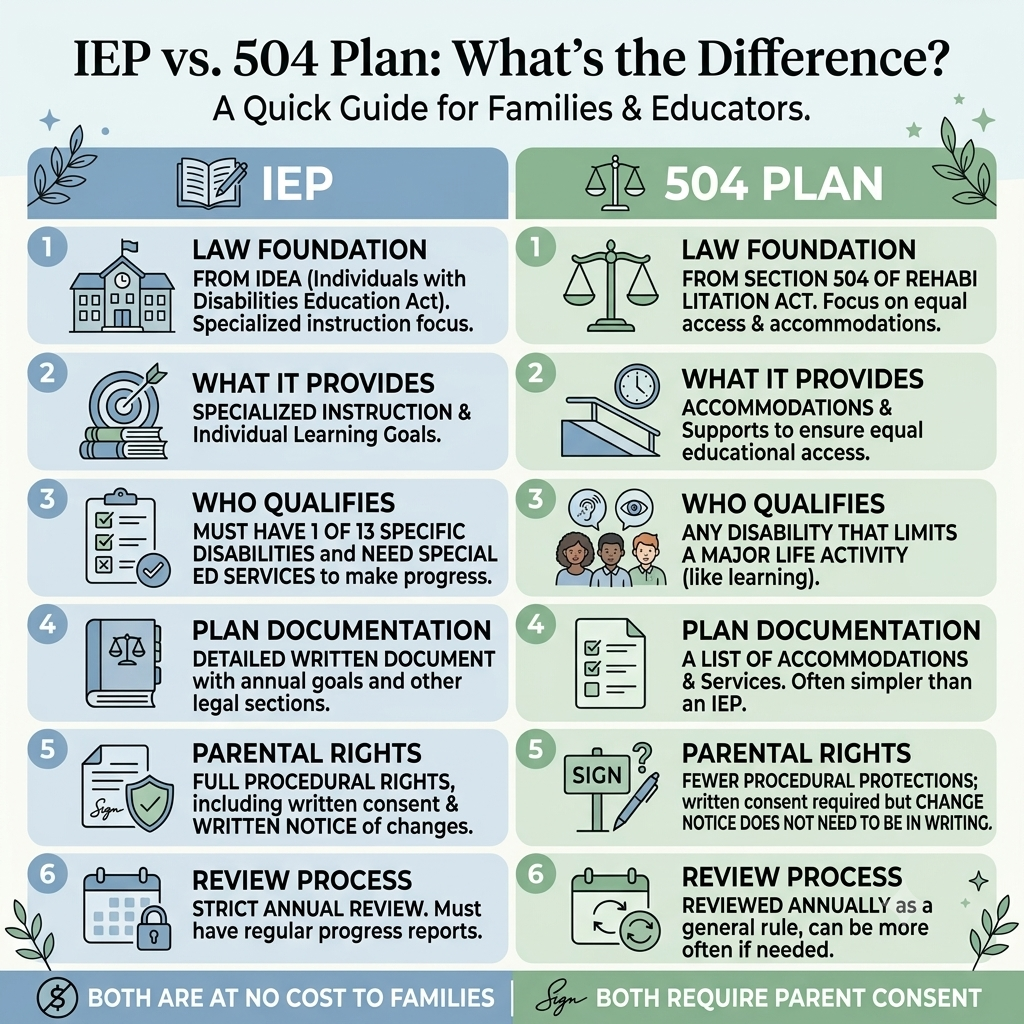
IEP vs. 504 Plan: What’s the Difference? A Quick Guide for Families and Educators
When your child is struggling in school, getting them the support they need should be straightforward. However, once you enter the world of special education, you are immediately met with an alphabet soup of acronyms and legal terminology.
Two of the most common frameworks you will hear about are an IEP (Individualized Education Program) and a 504 Plan. While both are designed to support students with unique learning needs at no cost to families, they serve different purposes, operate under different laws, and offer different types of support.
At Ascent Facilitation, our goal is to bring clarity to this process so you can advocate for your child with confidence. Let's break down the key differences between an IEP and a 504 Plan.
What is an IEP (Individualized Education Program)?
An IEP is a legally binding document created for students who require specialized instruction to make academic progress.
Key Takeaway: An IEP isn't just about accommodations—it changes what or how a child is taught by providing customized learning goals and specialized services.
1. The Legal Foundation
IEPs are governed by the Individuals with Disabilities Education Act (IDEA), a federal special education law that guarantees eligible students a Free Appropriate Public Education (FAPE) in the Least Restrictive Environment (LRE).
2. Who Qualifies?
To qualify for an IEP, a student must meet two strict criteria:
They must be diagnosed with a disability that falls under 1 of the 13 federal disability categories (e.g., Specific Learning Disability, Autism, ADHD under "Other Health Impairment", Speech/Language Impairment).
The disability must adversely affect their educational performance to the point where they require specialized instruction to learn the general curriculum.
3. What It Includes
An IEP is a comprehensive document that contains:
Specific, measurable annual learning goals.
Specialized instruction (e.g., modified curriculum, resource room support).
Related services (e.g., speech therapy, occupational therapy, counseling).
Accommodations and modifications.
Regular progress reports tracking development toward goals.
4. Parental Rights & Notification
Under IDEA, parents have extensive procedural safeguards. Your consent is required before any evaluation or placement, and the school must provide prior written notice before proposing or refusing any changes to your child's plan.
What is a 504 Plan?
A 504 Plan is designed to remove barriers to learning and ensure equal access to the general education environment.
Key Takeaway: A 504 Plan changes how a student accesses information, primarily through accommodations, without altering the core curriculum or providing specialized instruction.
1. The Legal Foundation
504 Plans are governed by Section 504 of the Rehabilitation Act of 1973, a federal civil rights law designed to eliminate discrimination against individuals with disabilities in programs receiving federal financial assistance.
2. Who Qualifies?
The eligibility criteria for a 504 Plan are broader than an IEP. A student qualifies if they have any physical or mental disability that substantially limits one or more major life activities (which includes learning, reading, concentrating, or communicating).
3. What It Includes
Unlike an IEP, a 504 Plan does not include specialized instruction or formal learning goals. Instead, it focuses on accommodations, services, and environmental modifications, such as:
Extra time on tests or assignments.
Preferential seating near the teacher or away from distractions.
Behavior intervention plans or sensory breaks.
Wheelchair accessibility or medical supports (e.g., diabetes management).
4. Parental Rights & Notification
Parents must provide consent to initiate a 504 Plan, and plans are typically reviewed annually. However, procedural protections are generally less formal than IDEA guidelines—for example, proposed changes do not always strictly require advance written notice.
IEP vs. 504 Plan: Comparison at a Glance
FeatureIEP (Individualized Education Program)504 PlanGoverning LawIDEA (Federal Special Ed Law)Section 504 (Civil Rights Law)Primary GoalProvide specialized instruction & goalsEnsure equal access through accommodationsEligibilityMust fit 1 of 13 disability categories + need special educationAny disability that limits a major life activityWritten Goals?Yes (Measurable annual goals required)No (Focuses purely on access and accommodations)Funding SourceAdditional state/federal IDEA fundingGeneral school funding (No additional IDEA funds)Written Notice for Changes?Required in writingNot strictly required in writingCost to FamiliesFreeFree
Which Plan Does Your Child Need?
Ask yourself these two questions:
Does my child need accommodations to access the regular classroom? (e.g., extra time, quiet testing, modified seating, wheelchair access)
Answer: A 504 Plan is likely the appropriate route.
Does my child need specialized instruction, modified lessons, or related therapies to learn and make academic progress? (e.g., specialized reading instruction, speech therapy, modified grade-level goals)
Answer: An IEP is likely required.
How Ascent Facilitation Can Help
Navigating school evaluations, eligibility meetings, and plan development can feel overwhelming. You don't have to sit at the team table alone.
At Ascent Facilitation, we help families prepare for school meetings, understand evaluation results, and collaborate productively with school teams to build effective IEPs and 504 Plans.
Ready to get the right support in place for your student?
Contact Ascent Facilitation today to schedule a consultation, or explore our advocacy services to learn how we can support your child's educational journey.